We Analysed 1,000 UK Debt Scenarios — Here's When Snowball Actually Beats Avalanche
Everyone says the debt avalanche saves more money than the debt snowball. We wanted numbers, not vibes — so we ran one thousand random but realistic UK-style debt portfolios through the exact same payoff engine as our free calculator. Here is what happened.
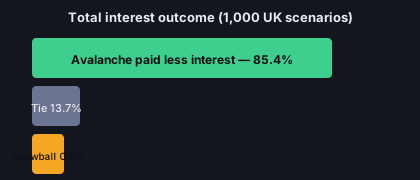
85.4%
Avalanche produced strictly lower total interest than snowball.
13.7% tied on total interest. 0.9% of runs where snowball beat avalanche on interest (9 scenarios out of 1,000).
Why we did this
Search results are full of opinion pieces. We already publish a calculator that compares avalanche and snowball transparently — so we could stress-test the conventional wisdom at scale. The question: across many different balances, APRs, numbers of debts, and extra payment levels, how often does each method actually win on total interest and on time to debt-free?
Methodology (so you can reproduce it)
We implemented the calculator's monthly loop in Node.js line-for-line with the JavaScript in index.html: apply monthly interest, pay minimums on every open debt, then apply the full extra payment to the priority debt (highest APR for avalanche, smallest balance for snowball). We capped runs at 600 months, matching the site.
Each scenario included:
- 2–6 debts with random splits of a total balance between roughly £1,500 and £48,000
- APR per debt drawn uniformly between ~6% and ~40% (typical UK unsecured range)
- Minimum payments set in a UK-realistic way (interest plus at least 1% of balance, floor £25), so minimums always clear interest with headroom
- Extra monthly payment randomised as a multiple of total minimums (so some people are barely over minimums, others are aggressive)
We used a seeded pseudo-random generator (seed = 20260402) so anyone can re-run our open script and get identical figures. The script lives in the site repository: scripts/simulate-1000.mjs.
Headline results
| Metric | Result |
|---|---|
| Avalanche strictly lower interest than snowball | 854 / 1,000 (85.4%) |
| Exact tie on total interest | 137 / 1,000 (13.7%) |
| Snowball strictly lower interest than avalanche | 9 / 1,000 (0.9%) |
| Avalanche faster or equal in months to debt-free | 741 / 1,000 (74.1%) |
| Snowball faster in months (may still cost more interest) | 259 / 1,000 (25.9%) |
| Median extra interest if you chose snowball vs avalanche (all scenarios) | £679 |
| 75th percentile of that gap | £1,684 |
| 90th percentile | £2,913 |
| Largest interest gap (avalanche advantage) | £6,555 |
The "median gap" is the middle value of (snowball total interest − avalanche total interest) across all 1,000 runs. Positive means avalanche was cheaper; in most realistic UK mixes, the difference is hundreds to a few thousand pounds.
By number of debts
Ties cluster heavily with two debts — when there are only two orderings, avalanche and snowball often attack the same account first (when the expensive debt is also the smaller one). With more debts, pure ties become rarer and avalanche's advantage grows.
| Debts | Scenarios | Avalanche wins | Tie | Snowball wins |
|---|---|---|---|---|
| 2 | 194 | 101 | 93 | 0 |
| 3 | 187 | 150 | 35 | 2 |
| 4 | 221 | 211 | 8 | 2 |
| 5 | 204 | 200 | 1 | 3 |
| 6 | 194 | 192 | 0 | 2 |
When does snowball "win"?
In this simulation, snowball beat avalanche on total interest in fewer than 1% of cases. That matches the theory: snowball can only beat avalanche on interest when the orderings cause strictly different payment paths that accidentally reduce interest — extremely unusual. More often, the methods tie because they start on the same debt (highest rate = smallest balance).
Months are a different story: snowball cleared all debts in fewer calendar months in about 26% of runs. That does not mean snowball was cheaper — it can finish sooner in edge cases while still costing more interest overall. Always compare both metrics with your own numbers.
Limitations
- Simulated data, not bank records — reality includes fees, 0% deals, payment holidays, and behaviour change.
- We did not model balance transfers or overdrafts separately; APRs are generic unsecured credit.
- Psychology matters: the best method is still the one you stick to. Our study measures interest, not motivation.
Run your own scenario — no spreadsheet required. Use the free avalanche vs snowball calculator to plug in your balances, APRs, and extra payment. You get the same engine this study used.
Related reading
For the conceptual background, read Debt Avalanche vs Snowball: Which Saves More Money in the UK? and our £10,000 worked example. If you are weighing a consolidation loan, see Debt Consolidation vs Avalanche & Snowball.