The Real Cost of Only Paying Minimum Payments on UK Credit Cards
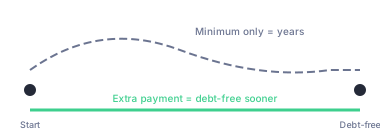
Paying only the minimum on UK credit cards feels manageable — until you see how long you’ll be in debt and how much you’ll hand over in interest. Here’s what’s really going on, and how to turn it around. (For a detailed timeline showing exactly how many years different balances take to clear, see How Long to Pay Off a Credit Card on Minimum Payments.)
How minimum payments work in the UK
UK card issuers typically set minimum payments as a small percentage of the balance (often 1–3%) plus fees and interest, or a fixed minimum (e.g. £5–25). That keeps the monthly number low, but it also means most of your payment goes to interest, not the balance. So the balance barely moves, and you stay in debt for years.
The numbers that hurt
Here are three realistic UK scenarios, all using the common minimum payment formula of 1% of balance plus interest (which roughly matches what many major UK card issuers use):
| Balance | APR | Years on minimums | Total interest | Total repaid |
|---|---|---|---|---|
| £2,000 | 19.9% | ~13 years | ~£1,700 | ~£3,700 |
| £3,500 | 22.9% | ~18 years | ~£3,600 | ~£7,100 |
| £5,000 | 24.9% | ~22 years | ~£5,900 | ~£10,900 |
The £5,000 example is particularly brutal: you end up repaying over twice what you borrowed, and you’re still making payments more than two decades later. These figures are rounded approximations — your exact numbers depend on your card’s minimum formula, but the pattern is consistent across UK issuers. Use the calculator with your real numbers to see your own timeline.
The reason this happens is mathematical. When your minimum is calculated as a percentage of the balance, the payment falls as the balance falls. In the early months a large chunk of that minimum is interest, not capital. The balance shrinks slowly, the minimum shrinks with it, and you can find yourself years in with a balance that barely looks different to where you started.
What you can do instead
You don’t need to double your payment to make a difference. Adding £50–100 a month on top of your minimums and putting that extra toward your highest-APR debt first (the avalanche method) will:
- Reduce total interest paid, often by hundreds or thousands of pounds.
- Shorten your time in debt, sometimes by years.
To see the real impact for your situation, use our free debt avalanche vs snowball calculator. Enter your cards (and any other debts), add an extra monthly amount, and you’ll see exactly how much interest you’d pay with minimums only vs with your extra payment — and how much sooner you’d be debt-free. No sign-up, no login.
How much difference does an extra £50 make?
A lot. Using the £3,500 balance at 22.9% APR example above — the one that takes 18 years on minimums alone — adding a fixed extra £50 per month on top of the minimum cuts the payoff to roughly 5 years and reduces total interest from around £3,600 to about £1,200. That’s a saving of over £2,400 just from finding an extra £50 a month.
| Monthly extra payment | Years to debt-free | Total interest paid | Saving vs minimums only |
|---|---|---|---|
| £0 (minimums only) | ~18 years | ~£3,600 | — |
| £50 | ~5 years | ~£1,200 | ~£2,400 saved |
| £100 | ~3 years | ~£750 | ~£2,850 saved |
| £150 | ~2.5 years | ~£580 | ~£3,020 saved |
These figures are for a single £3,500 card at 22.9% with a percentage-of-balance minimum. Your results will differ based on your card’s exact formula, but the pattern holds: even a small fixed extra payment makes a dramatic difference because it stops the minimum from shrinking with the balance. You pay more each month than minimums-only, which means more goes to capital, which means the balance falls faster, which means less interest accrues. Use the free calculator with your own balance and APR to see exactly how much you’d save.
Avalanche vs snowball when you’re breaking the minimum trap
Once you’re paying more than the minimum, the next question is which debt to put the extra toward. The avalanche method (highest interest first) usually saves the most money and gets you debt-free soonest. The snowball method (smallest balance first) can feel motivating but often costs more. We compare both in detail in Debt Avalanche vs Snowball: Which Saves More Money in the UK?; for a worked example with £10,000 across three debts, see that post. The calculator shows your exact interest and timeline for each method.
Key takeaways
- Paying only the minimum on UK credit cards maximises how long you’re in debt and how much interest you pay.
- Adding even £50–100 a month and targeting your highest-APR debt first (avalanche) can cut years and thousands off your payoff.
- Use a free calculator to see minimums-only vs extra-payment side by side with your real numbers.
Bottom line
Only paying the minimum on UK credit cards is one of the most expensive choices you can make — you pay for years and hand over far more in interest than you borrowed. Adding even a small extra payment and focusing on high-interest debt first (avalanche) can save you thousands and years. Use the free calculator to see your own numbers and plan your payoff.